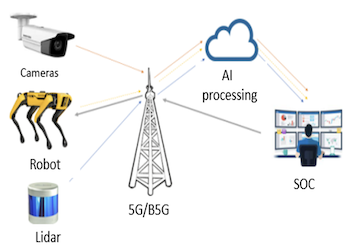
UC1 - Smart Crowd Monitoring (Madrid)
The trial at Movistar Arena demonstrated that 5G-enabled devices, including SPOT, SummitXL, and Temi robots, can be remotely controlled with end-to-end latencies below 12 ms, meeting operational requirements for real-time teleoperation. Throughput performance for individual devices was adequate, although downlink aggregate throughput (148 Mbps vs. 200 Mbps target) revealed potential bottlenecks for larger-scale deployment. LiDAR connectivity and limited millimetric-band coverage were identified as constraints for extending coverage to wider areas. Network reliability was maintained throughout the trial, but cybersecurity, fallback mechanisms, and scalability considerations remain essential for commercial deployment. Key takeaways for future 6G deployments include ensuring sub-10 ms latency for responsive robotic control, increasing uplink capacity for multiple high-resolution sensors, and integrating distributed edge computing to reduce processing delays. AI accuracy and device interoperability should also be addressed, while enhanced security, privacy protection, and extensive real-environment measurements are necessary to support large-scale commercial adoption.